Most companies don’t decide to implement an ERP system on a quiet afternoon. The decision usually arrives after months of small frustrations: sales promising stock that isn’t there, finance closing the month a week late, managers asking for a report that takes two days to assemble. Each problem looks minor on its own. Together, they are a sign that the business has outgrown the way its information is organised.
An Enterprise Resource Planning (ERP) system brings sales, purchasing, inventory, accounting, HR and operations onto one platform with one shared database. Done well, the implementation is less about installing software and more about giving the company a single, dependable way of working.
The hidden cost of disconnected systems
Growing businesses often run on a patchwork: an accounting package, a separate point-of-sale, stock in spreadsheets and customer details in email. Every hand-off between those tools needs someone to re-type, reconcile or double-check data. That work is easy to overlook because it is spread across many people, but it adds up quickly.
- Duplicate data entry — the same order or invoice is entered in two or three places.
- Inconsistent numbers — each department reports from its own version of the truth.
- Slow decisions — managers wait for reports instead of seeing live figures.
- Hard-to-scale processes — a new branch or product line multiplies the manual work.
What changes after an ERP implementation
One source of truth
When every module shares the same database, a confirmed sales order immediately reserves stock, creates the delivery and feeds the accounting entries. Teams stop arguing about whose spreadsheet is correct, because there is only one set of numbers.
Real-time visibility
Dashboards built on live data let management see cash position, open orders, stock levels and team workload at any moment. That makes it possible to react in days rather than at the end of the quarter.
Processes that scale
Approval rules, automatic reordering, recurring invoices and standard document templates mean the company can handle more volume without adding the same proportion of administrative staff.
How a successful implementation is structured
ERP projects succeed or fail on preparation. A phased approach keeps scope under control and gives the business visible progress at every step.
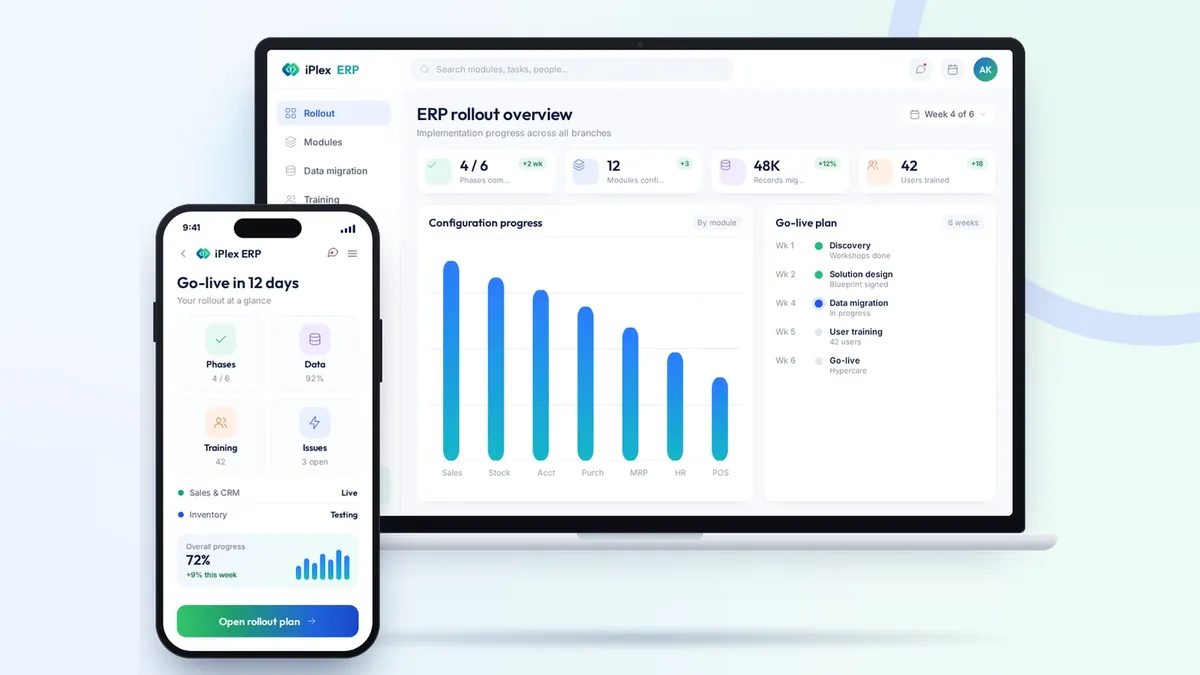
- Discovery — workshops with each department to map current processes, pain points and reporting needs.
- Solution design — decide which modules to use, how processes will run in the new system and what (if anything) needs customization.
- Configuration and data migration — set up the system, then clean and import customers, products, balances and open transactions.
- Testing and training — key users test real scenarios, then every team is trained on the tasks they actually perform.
- Go-live and hypercare — launch with close support during the first weeks, then hand over to ongoing support.
Common mistakes to avoid
- Trying to replicate every old spreadsheet instead of adopting better standard processes.
- Migrating years of unclean data without reviewing it first.
- Treating training as a single session the week before go-live.
- Leaving managers out of the design phase, then finding the reports don’t answer their questions.
Is it the right time for your business?
If your teams spend significant time moving information between tools, if month-end is getting slower, or if you are planning new branches, products or channels, it is usually the right time to start planning. The investment is easier to justify — and the implementation is simpler — before the workarounds become deeply embedded.
A short discovery conversation is a practical first step: it clarifies which modules you need, what the rollout would look like and what budget range to expect, before you commit to anything.
Need help with your project? Talk to the iPlexSoft team for a free, no-obligation consultation.