Artificial intelligence has moved from experiment to everyday tool, but many businesses are still unsure where it fits. The most valuable uses are rarely futuristic. They are practical improvements to processes that already exist: reading documents, routing requests, answering routine questions and spotting issues earlier.
AI automation combines traditional workflow automation — rules, triggers and integrations — with AI models that can understand text, documents and patterns. The result is automation that can handle work which used to need a person to read and interpret it.
Where AI automation helps most
Document processing
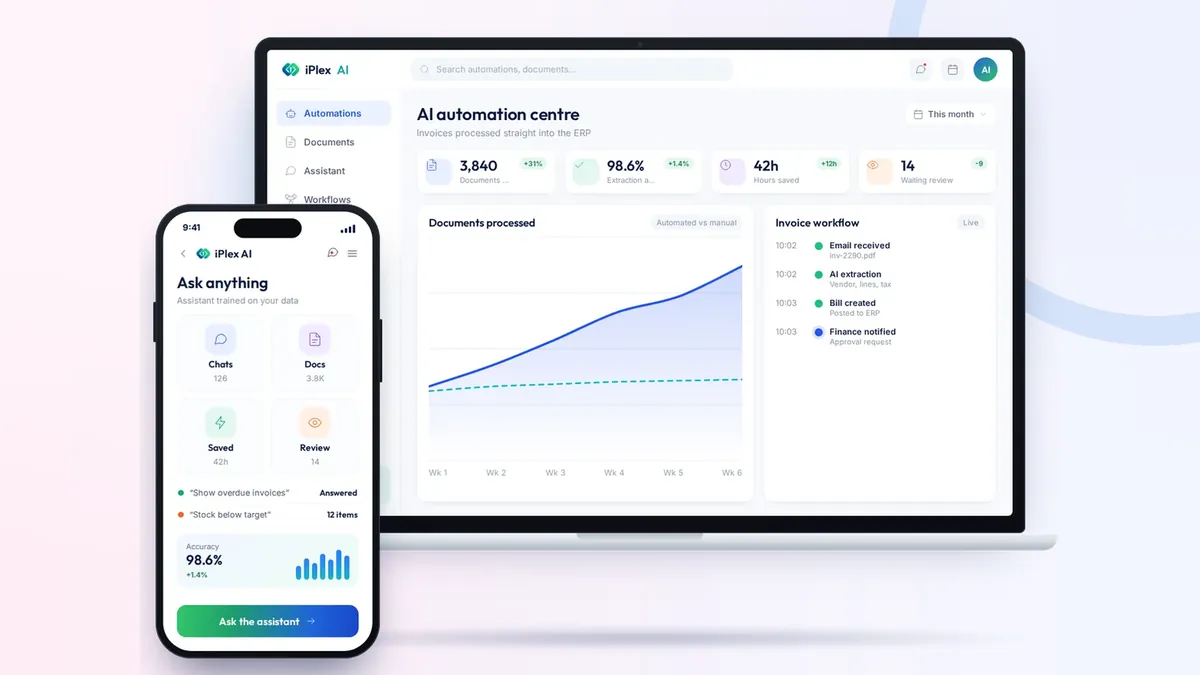
Supplier invoices, purchase orders, delivery notes and forms can be read automatically, with key fields extracted and entered into the ERP. Staff review exceptions instead of typing every document.
Customer and internal support
Assistants trained on your own policies, product information and procedures can answer routine questions, draft replies and route complex cases to the right person with the context already gathered.
Workflow routing and approvals
Incoming requests, emails and tickets can be classified and sent to the right team automatically, with urgent items flagged for attention.
Forecasting and early warnings
Patterns in sales, stock and payment data can highlight likely shortages, overdue risks or unusual transactions before they become problems.
Choosing the first use case
The best first project is narrow, frequent and measurable. Look for a task that:
- Happens many times every week.
- Follows a recognisable pattern most of the time.
- Currently relies on people copying, reading or sorting information.
- Has a clear measure of success, such as time per document or response time.
Document processing and support assistants are common starting points because they meet all four criteria and show results quickly.
Introducing AI responsibly
AI automation should make teams more effective, not remove judgement from important decisions. A few principles keep projects safe and trusted:
- Keep a human in the loop for approvals, payments and anything customer-sensitive.
- Protect data — know where information is processed and stored, and limit access to what each process needs.
- Measure accuracy on real examples before and after launch.
- Be transparent with staff and customers about where automation is used.
- Start small and expand once the first process is stable.
Connecting AI to the systems you already use
AI delivers the most value when it is connected to your ERP, CRM and communication tools rather than running as a separate application. Extracted invoice data should create the bill in the accounting system; a support assistant should be able to look up an order status. That integration work is often what turns a promising demo into a dependable everyday process.
Getting started
A short assessment of your current processes usually reveals two or three tasks where automation would save meaningful time. Starting with one of them, measuring the result and expanding from there is the most reliable path to lasting value.
Need help with your project? Talk to the iPlexSoft team for a free, no-obligation consultation.