For many companies, web applications have quietly become critical infrastructure. Customers place orders and track deliveries through portals, staff run daily operations in browser-based tools, and the company website is often the first impression a prospect gets. When those applications are slow, insecure or unable to handle growth, the effects show up directly in revenue and reputation.
Speed is a business requirement
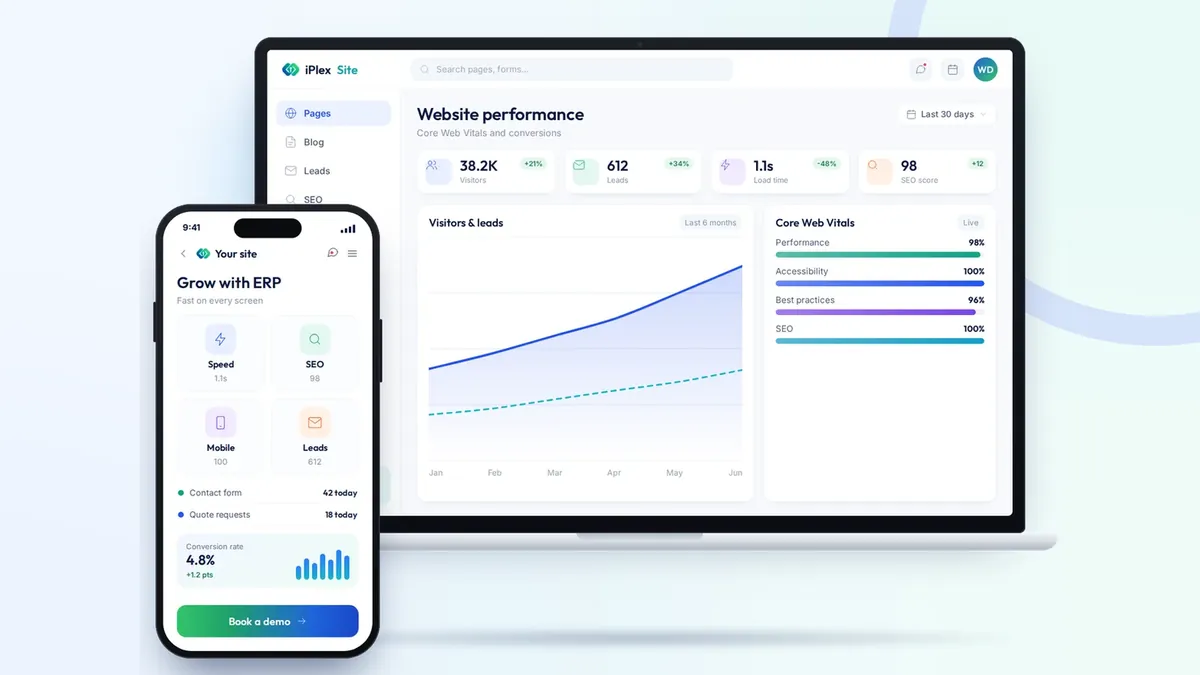
Users expect pages and screens to respond almost instantly. Slow applications lead to abandoned forms, frustrated staff and lower search visibility, because search engines consider page experience when ranking websites.
What makes a web application fast
- Lightweight front-end code that loads only what each page needs.
- Optimised, modern image formats and lazy loading for content below the fold.
- Efficient database queries and caching for frequently used data.
- Hosting and content delivery that place the application close to users.
Security protects customers and the business
Web applications often handle personal information, payments and confidential business data. A single vulnerability can lead to data loss, downtime and lasting damage to trust. Security needs to be designed in from the start, not added afterwards.
Security essentials
- Encrypted connections (HTTPS) everywhere.
- Strong authentication, with role-based access and multi-factor login for administrators.
- Input validation and protection against common attacks such as injection and cross-site scripting.
- Regular updates to frameworks, libraries and servers.
- Backups that are tested by actually restoring them.
- Monitoring and alerts for unusual activity.
Scalability prepares you for growth
An application that works for fifty users may struggle with five thousand. Scalability is the ability to handle more users, more data and more features without a complete rebuild.
It depends on choices made early: a clean architecture that separates the interface from business logic, databases designed for growth, APIs that allow other systems and mobile apps to connect, and infrastructure that can add capacity when demand increases.
Connected to the rest of the business
The most useful web applications don’t work in isolation. A customer portal that shows live order status from the ERP, or a field-service app that updates stock and invoices automatically, removes manual steps and gives users accurate information. Planning these integrations from the beginning avoids expensive changes later.
Building or modernising: what to look for
- Clear requirements based on real user journeys, not just a feature list.
- Responsive design that works equally well on phones, tablets and desktops.
- Accessibility so the application can be used by everyone.
- Measurable performance goals for load time and responsiveness.
- A maintenance plan covering updates, monitoring and support after launch.
The long-term view
A well-built web application becomes a stable foundation the business can extend for years. Investing in speed, security and scalability at the start costs far less than fixing an application that was built only to launch quickly.
If an existing website or portal feels slow, hard to update or disconnected from your other systems, a short technical review is a practical way to identify the improvements that will make the biggest difference.
Need help with your project? Talk to the iPlexSoft team for a free, no-obligation consultation.